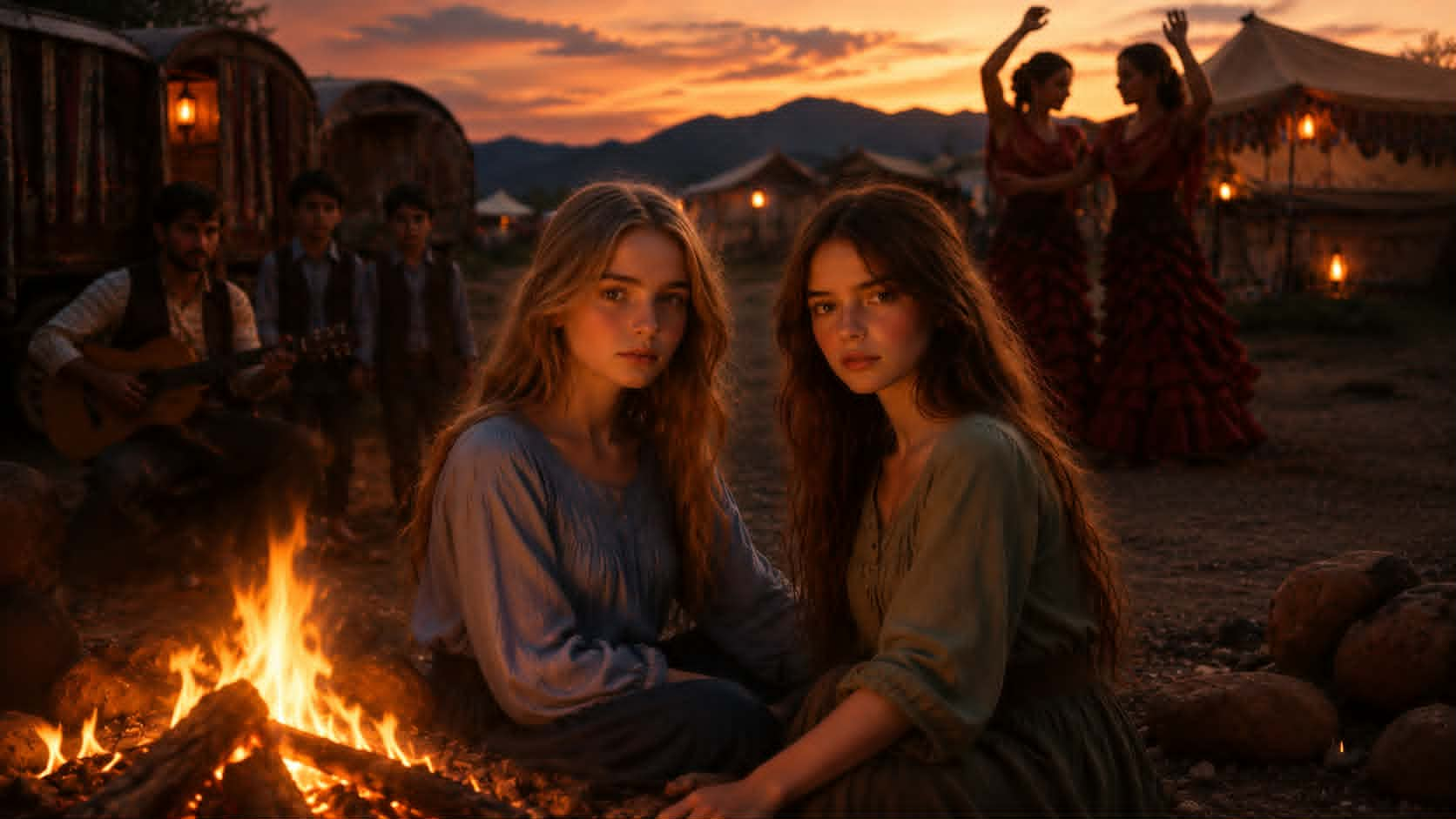
Oral tradition within peoples is a notion that has always scared me as much as fascinated me. With age, I end up believing that I have placed far too much emphasis on beliefs and not enough on superstitions.
Of course, nothing happens by chance. The culture in which I grew up brought me my beliefs, and my experience is responsible for my fear of superstitions.
I'm a bohemian.
I was born in the hills that dominate Granada, somewhere between the caves of the Sacromonte and the fertile lands of the Vega. When I was a child, it was enough to climb up the heights at sunrise to see the Alhambra inflamed by morning light, while in the distance the snowy peaks of Sierra Nevada seemed to float above the clouds.
Our camp existed long before I was born.
According to Ella, our patriarch, his story dates back to the year 1512. The elders said that our ancestors were children of this land. Iberians, they said, mingled over the centuries with all those who had passed through Andalusia without ever getting to rip off their roots. From the Romans to the Moors, from the kings to the soldiers, the generations had marched while our people stayed there, between the river and the hills.
I don't know if this was all true.
Elders like to adorn stories.
But when Ella talked about our ancestors, no one ever interrupted him.
At that time, Spain was still living under Franco. I didn't understand what that really meant. I just knew that some subjects silenced adults. When the men of the Guardia Civil crossed the region, the conversations changed abruptly. Laughter became more discreet. Guitars continued to play, but words were scarce.
The years were hard.
The large landowners owned most of the land in the Vega of Granada and many of the men in our camp worked at the rhythm of the seasons. Some of them went for the crops. Others sold horses or lived on the street. The older men repaired everything that could be.
And then there were the disappearances.
Three weeks before I was born, Mea, my mother's best friend, died in childbirth.
A few weeks earlier, her husband had disappeared.
The same evening as my father, it was a thing frequent enough for no one to really wonder, in our community, some men left at nightfall. If they hadn't come back in the morning, everyone knew they'd never come back.
No suit.
No research.
No explanation.
Only silence and taboo.
My mother then took Mea's child, her name was Maeva, she was going to become my sister, and today I believe that it was that day that fate began to write our story.
For several generations, very few children were born in our community. When we were born, Maeva and I were the only two girls in the camp.
For the elders, it was a sign.
For the boys, that was a problem.
Throughout our childhood, they were raised in the idea that one day they should marry one of us. Not out of love, but because our people were aging and slowly disappearing.
To become the husband of Milenca or Maeva almost amounted to becoming the leader of the camp, even if, in truth, everyone knew that the women were already ruling because, the men left, the women remained and that it had always been so.
The problem with princesses is that in their own ways, they're full of brilliance.
I liked walking barefoot in the water. From as far back as my memories go, the sound of the river has always brought me more peace than the songs of the elders.
Maeva preferred the hot stone.She could sit for hours in the shade of a cliff, bare feet on the rock, looking at the sky without saying anything.
We were inseparable and unbearable. Every day the boys pursued us through the camp and every day we found a new way of escaping them.
We had no secret hiding place, no secret refuge, we were just constantly changing places.
An abandoned cave, a grove by the water, a rocky promontory, an old forgotten ruin. Wherever we could be alone.
I still remember Mom's anger.
When the sun began to disappear behind the hills, it often went in search of us, accompanied by Ella. Ella knew every path in the area, every tree, every stone, every corner where the two little idiots we were could have the idea of hiding.
Once we were taken back to the camp, we were condemned to listen to the adult demonstrations while the boys continued their nonsense around the fire to attract our attention.
The elders played guitar, the women prepared the meal, the children laughed, and for a few hours everything seemed normal.
Sometimes, during the summer evenings, we saw strangers going up to the caves of the Sacromonte. The number of tourists was increasing.
They came to see the Gypsies dancing flamenco. The elders hated that. They said flamenco wasn't a show, it wasn't something we were selling, it was a way to tell life, the dead and the absent.
At the time, I didn't understand their words, I just thought they were old and old people always found something to blame young people.
Then we grew up and our getaways took us ever further, until the day we crossed the river.